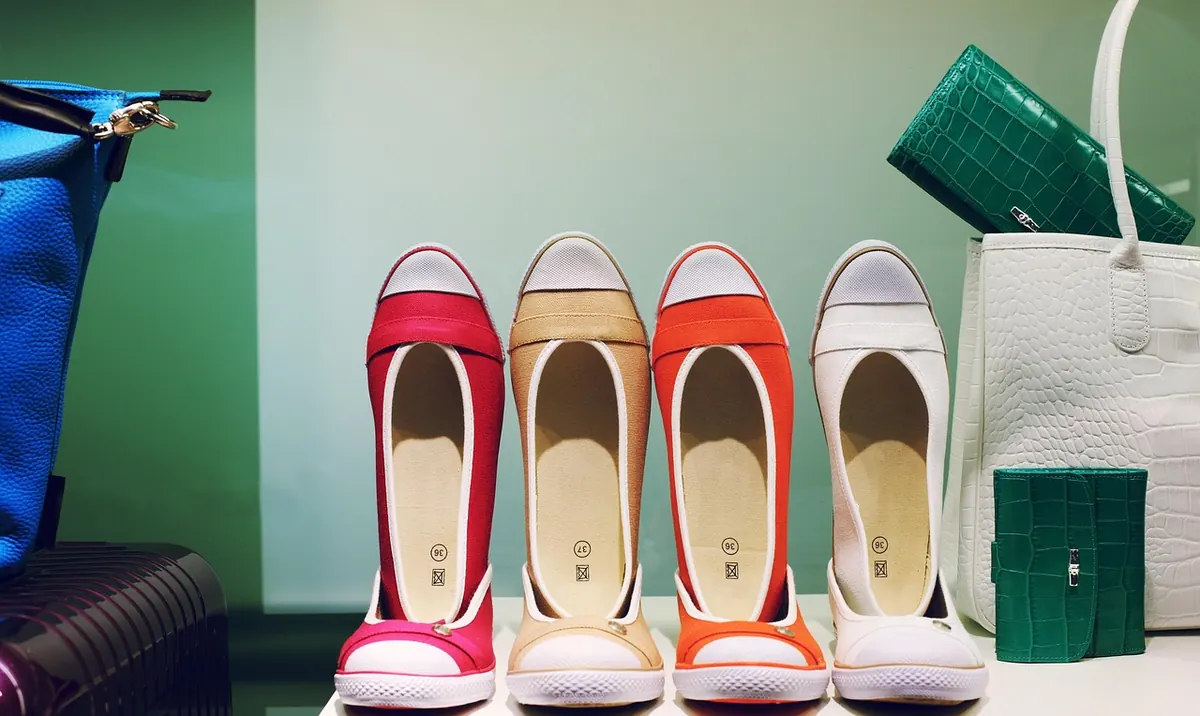
A handbag and a pair of shoes in the same leather, the same shade, the same gold clasp: on paper, tidy. On a real person, it can read like a uniform — and not in the good way. The fully matched set looks like a purchase rather than a choice, which is why it so often feels a decade behind everything else you're wearing.
You don't have to give up coordination. You just have to loosen it. Bags and shoes should look like they live in the same wardrobe, not the same box. Here's how to build that relationship without a matching set in sight.
Why an exact match reads dated
Your eye wants somewhere to travel. When the bag and shoes are identical, the eye lands on one, finds the same thing again, and stops looking. Nothing in the outfit feels discovered.
There's history behind it, too. Matching accessories once signalled that everything had been made or bought together, back when choice was limited and a coordinated set was a mark of care. Now that we can pair almost anything with anything, the same move looks effortful rather than effortless. What you want instead is echo — two pieces that answer each other rather than repeat each other.
Aim for echo, not duplication. One shared note is enough.
Pick one element to repeat, then let the rest diverge
Your bag and shoes need a single shared thread, not three. Choose one and let everything else drift:
- Colour family — both warm browns, both cool greys, both in the navy-to-denim range.
- Texture — both smooth leather, both suede, both woven.
- Hardware or trim — both gold-tone, both with contrast stitching, both with a visible buckle.
- Formality — both relaxed daytime pieces, or both polished enough for dinner.
Brown suede ankle boots with a black leather shoulder bag work because the texture and the mood agree while the colour doesn't. Black patent loafers with a matte leather tote work because the colour agrees while the finish deliberately doesn't. In both cases there's one clear link and one clear difference, which is exactly what makes the pairing look chosen.
Think in colour families, not colour codes
Stop trying to match a specific shade and start working in ranges. Black, charcoal and grey form one family. Navy, denim and chambray form another. Tan, cognac, caramel and chocolate are all relatives. Ivory, cream and oatmeal sit together comfortably.
Two pieces from the same family in different depths look intentional. Two pieces from different families need a bridge — a print that contains both, a belt, a scarf, or jewellery that picks up the metal on the bag.
A few moves that reliably work:
- Let the bag be the statement and treat the shoes as neutral. Black, brown, cream, nude or metallic shoes will happily carry a printed, bright or unusual bag.
- Pull one colour out of a printed bag and put it in a solid shoe, or reverse it with a patterned shoe and a plain bag.
- Use metallics as connectors. A silver or gold shoe behaves like a neutral, so whatever bag you're holding still reads.
- Break up an all-one-colour outfit. Head-to-toe black with black bag and black shoes flattens you into a silhouette. Swap one accessory for cognac, cream or suede and the whole look gains depth.
Texture breaks the match faster than colour
If you only adjust one thing, adjust this. A smooth leather bag against suede shoes gives the outfit a surface change your eye can enjoy. Patent shoes with a matte leather bag do the same job. A canvas or raffia bag with leather sandals feels summery and relaxed; a croc-embossed bag with plain leather loafers adds interest without adding colour.
As a rough guide, three textures across the whole look — outfit included — is usually plenty. Knit sweater, denim, suede boots: done. Add a woven bag and you're at four, which starts to look busy. When the textures are doing a lot of talking, keep the colours quiet.
Keep formality in the same room
A mismatch in dressiness is more jarring than any colour mistake. A canvas tote next to satin evening heels doesn't read as playful; it reads as unfinished. Think of a simple scale, from one to five: one is beach and gym, two is casual daytime, three is smart casual, four is office or dinner, five is evening and occasion wear. Your bag and shoes should sit within one step of each other.
White sneakers at a two with a structured leather shoulder bag at a three? Fine. The same sneakers with a satin clutch at a five? The outfit can't recover from that gap, no matter how good each piece is on its own.
When breaking the rule is worth it
Contrast works when the outfit clearly supports it and one piece is obviously the casual anchor. A tailored suit with clean white sneakers is a settled pairing. A soft knit and jeans with a polished structured bag is another. The contrast has to look like a decision, not an accident I forgot to fix.
Worth saying plainly: for genuinely formal occasions — black tie, certain ceremonies, some conservative workplaces — a coordinated bag and shoe is correct, and these looser rules don't apply. Dress codes are their own argument.
Watch weight, proportion and hardware
Heavy lug-sole boots next to a tiny clutch is a struggle your eye can't resolve. Chunky shoes want a substantial bag; delicate heels want something small and refined. It's about visual weight, not size in centimetres.
Metal is the last thing to check. Mixing gold and silver is completely fine — it's when the jewellery, the belt buckle, the bag clasp and the shoe hardware are all fighting that things get noisy. Pick one finish to lead and let the rest stay quiet.
The pre-exit check
Before you leave the house, run through this. It takes fifteen seconds and saves a lot of second-guessing.
- Is there exactly one clear link between the bag and the shoes — colour, texture, hardware or formality?
- Are they within one step of each other on the dressiness scale?
- Does the visual weight balance, or is one piece dwarfing the other?
- Is one piece carrying the personality while the other supports it?
- Could you swap the shoes for a near neighbour — loafers for boots, flats for a low heel — without rethinking the bag? If yes, you've built a system rather than a match.
That last question is the one that matters most. Matching sets are a decision you make once and repeat forever. A small rotation of bags and shoes that all share a loose logic gives you far more outfits from the same closet. Keep three or four combinations you trust and stop rebuilding the equation every morning.
Photo: andreas160578 / Pixabay